
Hiring Framework
How to optimise the recruitment process. Are inefficiencies costing you time, money & talent?

S. Connie
Published on 18th July, 2022

7 min
The recruitment industry has faced immense challenges in the past few years.
While the global staffing industry has more-or-less bounced back to pre-pandemic levels, capturing the top talent required to help businesses grow is still exceptionally difficult. In fact, some 72% of businesses consider talent availability a major roadblock to growth.
Businesses need to optimise the recruitment process to attract the talent and skills they need.
Here, we’ll explore common recruitment inefficiencies and how to remedy them.
Recruitment process definition
The recruitment process involves creating job ads, conducting candidate outreach, collecting inbound applications, screening and interviewing individuals, and onboarding and training them.
A recruitment process involves multiple steps that are typically managed by an HR or hiring team. The end result of a successful recruitment process is a successfully onboarded, engaged employee.
Recruitment process map
Recruitment involves multiple stages. Recruitment process stages progress from initial planning, creating ads and conducting outreach to screening, onboarding, etc.
Here’s typical 5-step recruitment process map:
1: Planning and preparing
First and foremost, it’s necessary to determine what’s required for the business. HR staff might receive direction from elsewhere in the business, or deciding on who to hire might be a more collaborative process.
Researching the proposed new positions is critical, especially if staff don’t have expertise in those roles. For example, if a business is looking to hire a developer, it’s necessary to understand the different types and specialisms so accurate job ads can be produced.
- Collaborate with relevant teams to identify skills gaps
- Research positions in detail to establish niche job skills, traits, characteristics, etc
- Start to prepare job ads
Once job specs are decided, it’s time to create adverts for placement on job boards and recruitment websites. It may also be necessary to conduct outreach to locate passive jobseekers.
It’s necessary to keep track of what ads are posted on what channels to ensure continuity and organisation.
- Design job ads and get them checked by multiple team members
- Place ads on job channels
- Keep ads and channels well-organised
Screening involves multiple stages progressing from initial checks of skills, education, work experience, etc, to interviews, etc. Collecting references is essential, while conducting vetting is necessary for some positions.
Many hiring teams can benefit from analysing their recruitment process, as this can shape candidates’ experiences while also enabling the business to really understand candidates beyond the usual stereotypical interview questions.
- Screen candidates for skills, qualifications, education, etc
- Conduct in-depth interviews
- Ensure this is swift and effective to avoid unnecessary delays
Job offers should be made promptly once decisions are made - no point in hanging around.
This also accelerates onboarding, thus decreasing time-to-productivity. Candidates should be informed of what they need to do to confirm the job, including any paperwork that needs to be submitted.
- Make timely offers with plenty of detail
- Inform candidates of what they need to do to confirm the offer
- Begin onboarding and training
Recruitment processes are dynamic and should adapt to different job roles. Conduct regular evaluations to ensure everything is meeting expectations. Ask for candidate feedback and act on it to refine the recruitment process.
- Analyse recruitment data to discover useful trends and insights
- Collect feedback from candidates
- Modernise recruitment processes to drive efficiencies
The job market today
Recruitment is bouncing back from the slump induced by the pandemic, with 93% of employers expecting to hire in 2022 – up from 82% in 2021.
Of course, this is a good thing for recruiters, but it’s promoted an interesting discussion about the challenges recruiters face in today’s market.
For example, figures from the ONS Labour Market show the UK now has more vacancies than unemployed people. This is mirrored across Europe and in the US - the US job market saw employment increase by 372,000 in June alone.
It’s evident that we’re in a saturated job market, and it’s making things increasingly difficult for recruiters: confidence in finding the right candidate has fallen for the third year in a row.
This has real consequences:
Taking on subpar talent is a costly mistake for companies
Almost $15,000 is lost for each bad hire a company employs. This is in part due to a 36% drop in productivity, but it’s also because of an increased turnover rate from the 32% drop in employee morale.
You’ve also got to consider the time lost from the recruitment process. If the recruitment process fails to screen candidates properly, the risk of making the wrong hire increases further.
Making good hiring decisions boosts productivity
Many successful enterprises and startups attribute their success to rock-solid hiring and HR practices.
For example, a Deloitte report found that 83% of executives and 84% of employees believe that motivated and engaged employees are a major factor in business success, and much of this engagement is built into the recruitment process.
After all, recruitment is the hook that pulls individuals to a company. Recruitment is woven into business success from the minute they read a job ad to the first correspondence they receive.
Optimising hiring drives growth
Recruitment optimisation leads to growth in productivity, revenue and ultimately, profits and growth. Many of the world’s largest businesses have slick recruitment processes that help engage employees from the get-go.
Businesses that invest in excellent hiring processes are more likely to thrive. Some 70% of enterprise CEOs rate recruitment as a top-5 business priority and better matching of candidates to jobs raises revenue and profits.
Outdated recruitment methods aren’t helping
Market conditions aren’t the only factors that contribute to recruitment difficulties. Surveys show that recruiters are struggling to modernise their processes to align with what the modern industry demands.
To combat this, recruiters are increasing their budgets and investing in new technologies.
- 48% of survey respondents in a Bullhorn survey increased operational budgets increased in 2022
- 49% of recruiters increased their technology budgets in 2022
Let’s look at how businesses can modernise the recruitment process.
Candidate experience is key
Recruitment and selection are burdensome, high-responsibility tasks. Recruiters often have to ‘swivel chair’ between juggling candidates, doing the admin work, and communicating with key stakeholders.
Sometimes, providing an exceptional candidate experience shuffles down the priority list, and outcomes start to decline. Allowing this to happen is a critical error that could totally derail recruitment efforts.
Statistics show that a positive candidate experience increases the odds a candidate will accept a job by 38% more likely to accept a job, and 60% might abandon the process if it’s too complicated or arduous.
Further, candidates often highlight poor communication as a sticking point in the recruitment process.
- Delivering an exceptional candidate experience gets new employee relationships off on the right foot.
- Failing to provide a quality candidate experience might lead to poor ratings, testimonials and reviews.
- Lack of communication is one of the primary sticking points associated with the candidate experience.
- Candidate experience is a precursor to higher engagement and, by extension, growth.

A bad candidate experience is costly
Even for those that power through a difficult application, 73% rate job hunting as one of the most stressful experiences in their life. Some 64% of candidates will share a bad hiring experience with their friends and family.
>If an applicant is rejected and doesn’t receive any feedback, they’re 2x more likely to never do business with that company again.
Providing a great candidate experience is somewhat of an easy win - keeping stress low for candidates will likely leave a mark. By taking the time to keep candidates informed, you’ll secure a larger talent pool and make engaging hires that boost morale. It’s a win/win situation.
Also, candidates that receive a positive experience might share that with others which is crucial for building a stronger company culture.
Taking the time to deliver a smooth and enjoyable candidate experience is a highly effective strategy for building a stronger company culture.
- Many candidates receive a poor hiring experience, making it easier to stand out for recruiters that go the extra mile.
- Recruitment is foundational to company culture.
- Candidates share both positive and negative hiring experiences but are more likely to share negative ones.
- Treating candidates with respect and attention increases engagement and retention.
How to optimise the recruitment process
Digital transformation is linked with recruitment success, and evidence suggests that recruiters who invest in technological solutions are likely to cut through the noise and make successful hires.
Technological investment is more-or-less mandatory now, and businesses must seek to innovate paper processes wherever possible. Bullhorn found that there’s great appetite for technological investment, with some 95% of recruiters citing that they’re investing in digital transformation.
In short, transformation is centred on the following areas:
- Sourcing
- Screening
- Candidate management
- Organisation payrolling
- Vendor management systems (VMS)
Here are 3 ways that transforming the recruitment process can enhance the hiring process.
Make smarter decisions with data
Many businesses have already invested in new technology and processes over the years. The problem is, businesses are now using multiple recruitment systems and tools that don’t talk to each other.
This is sometimes called ‘SaaS sprawl’ - which refers to the bloat some companies suffer when investing in too many siloed tools.
Not only does this affect hiring efficiency, it stops businesses from leveraging their data.
An all-in-one recruitment solution Hiringmaster is the answer. Capture all your data in one place,, and you'll unlock several benefits: an easy overview of your operations, insights into problems, and better decision-making.
Candidate filtering with a data-driven approach

52% of recruitment leaders find screening candidates the most difficult part of their role, and 45% of employers claim they can’t find appropriately skilled workers. The problem is, traditional filtering is inefficient because it’s done either by recruitment consultants or separate systems.
Moreover, it’s not only important to find the right talent; you have to find them quickly. A newly listed vacancy takes about 27 days to fill. Further, high-value candidates secure a position within 10 days.
Speed is of the essence, which makes data centralisation all the more important. If all your data are stored in one location, you’ll be able to screen candidates effectively without jumping from one tool to another. A tool that supports custom filters allows you to leverage all the information you’ve collected without performing lengthy manual searches.
The time-saving benefits of tech
Outdated recruitment agencies and HR teams are killing their productivity by doing a lot of work manually: sorting resumes, reviewing all the candidates, inputting and retrieving data from multiple systems, and much more.
Modernising recruitment involves breaking tasks down into bitesize segments that can be assigned to different team members, centralising actions in a single-source-of-truth for seamless excess to candidate data, and streamlined integration of screening and onboarding processes.
Getting rid of paper processes in favour of an all-digital recruitment strategy benefits both HR staff and candidates.
It’s no surprise that 94% of recruiters and HR professionals say recruitment software has had a positive effect on their hiring process. Recruitment tech is bringing massive improvements to the industry, but blindly adding new tools isn’t the path to success.
- Recruitment software like Hiringmaster organises the entire recruitment process with an intuitive visual UI.
- Cross-collaboration tools keep teams reading from the same scripts.
- Collect crucial candidate data for analysis
- Use candidate relation management (CRM) to organise communications between candidates
- Personalise and customise the recruitment process to the business’s unique needs.
- Hiringmaster handles all the above features and more
4 fundamental principles to eliminate inefficiencies from the recruitment process
The top recruitment teams recognise that a better approach is needed, one that. You’re no longer wasting time on the admin side of things. Instead, everything is streamlined and follows a sensible process to maximise efficiency.
A well-organised recruitment system frees you to focus on what really matters - the talent.
Final thoughts
It’s easy to see why 68% of hiring personnel think adopting new tech is the best way to boost recruitment performance. We’ve seen how adopting a modern approach to recruitment will benefit your company in numerous ways.
With all the time-saving benefits of an organised system, you’ll be free to focus on delivering an enjoyable candidate experience, leading to a larger and better candidate pool. In addition, you can quickly screen these clients to find the best talent when you leverage the power of data.
Your company needs to use an all-in-one recruitment tool to compete in the current market.
If you’re looking for one, we’d recommend Hiringmaster. It’s a modern recruitment solution designed to address every challenge addressed in this post. Get started for free.

Boost productivity while saving time and money
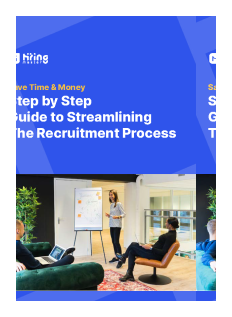
4 fundamental principles to eliminate inefficiencies from the recruitment process.
Contents
- Recruitment process definition
- Recruitment process map
- The job market today
- Outdated recruitment methods aren’t helping
- Candidate experience is key
- A bad candidate experience is costly
- How to optimise the recruitment process
- 4 fundamental principles to eliminate inefficiencies from the recruitment process
- Final thoughts

