
Hiring Framework
Trends in the Recruitment Industry 2022: Hiringmaster’s Retrospective

S. Connie
Published on 23th November, 2022

7 min
It’s no secret that the past few years have presented immense challenges for businesses across the world.
The coronavirus pandemic catalysed changes in office, remote and hybrid working while also profoundly affecting business operations. As a result, recruitment’s role within the business is changing, and the industry has evolved.
As the road to recovery progresses at a meandering pace, recruiters are wondering where the industry is heading now. What are the industry's strengths and weaknesses, and what do recruiters need to be aware of going forward?
In response to Bullhorn’s fascinating report on the trends in the recruitment industry 2022, we’re sharing our own thoughts on the subject.
2022: The road to recovery
The recruitment industry trends of 2022 on the whole represent a partial recovery from the pandemic slump. But uncertainty continues, especially with regard to increasing inflation, price pressure and job shortages.
Recruitment has bounced back as the job market rejuvenates with fresh opportunities. 93% of employers did some hiring in 2022, a steep increase from 82% in 2021. It would seem the appetite for growth has returned, as businesses feel like they can plan for the future rather than react to the present.
A new wave of jobseekers
Employees that became agitated in their roles throughout 2020 and 2021 have started looking for new jobs, boosting activity for recruitment agencies and hiring professionals.
2020 was particularly challenging for recruitment agencies, with two out of five agencies reporting revenue losses. Contrastingly, 2021 represented a rebound, with three out of five agencies reporting revenue gains and just one of seven reporting losses. Statista figures concur, showing a colossal dip in the pandemic followed by a strong rally to more-or-less pre-pandemic levels.
IT and technology companies reported the highest gains, with 68% in that group reporting revenue increases. Light industrial firms sat at the other end of the spectrum. Additionally, North American and APAC respondents reported higher revenue gains than those in Europe.
Budgets and investments
As recruitment revitalises, budgets are once again increasing.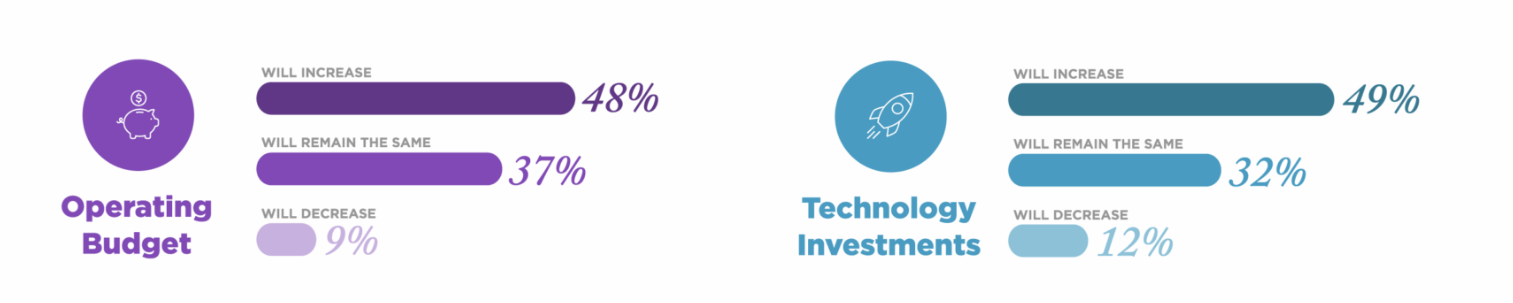
- 48% of Bullhorn survey respondents say their operational budgets have increased in 2022
- 49% say their technology investments have increased in 2022

Priorities for recruitment
There has been somewhat of a paradigm shift in recruitment priorities. In 2020 and 2021, winning clients and new business was a top priority for agencies. Whereas now, talent acquisition has taken over. 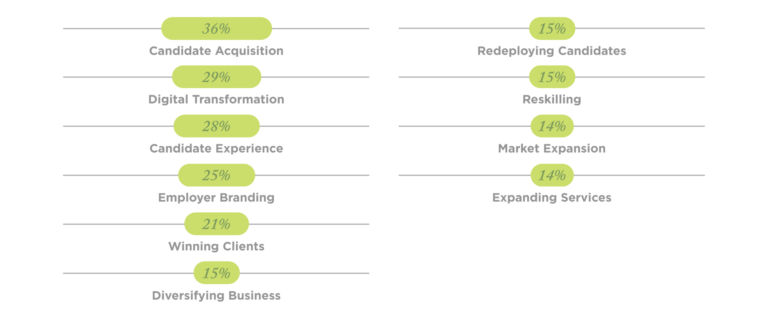
Why? Businesses can’t commit to more business without the talent to back up new relationships. Growth is impossible without the talent to fuel it, hence why competition for certain in-demand jobs is intensely high.
Of businesses surveyed by Bullhorn, a 36% majority highlighted talent acquisition as a priority, whereas 29% highlighted digital transformation. Candidate experience was next at 28%, within winning new clients filling the 5th spot at 21%.

Boost productivity while saving time and money
4 fundamental principles to eliminate inefficiencies from the recruitment process.

Challenges for recruitment
Of course, recruiters continue to face potent challenges. The industry has become more complex in recent years, and traditional recruitment processes are being slowly phased out. 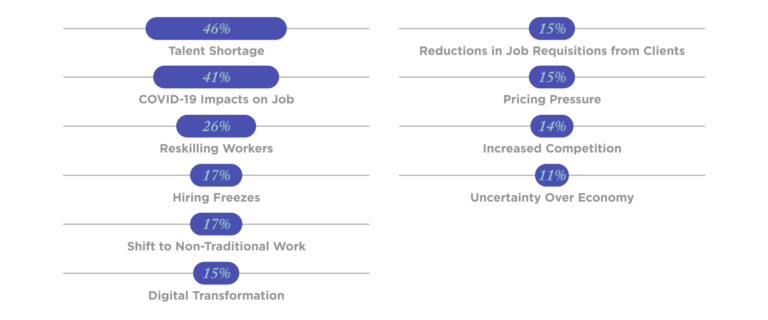
The top 10 challenges (in order of the biggest to the smallest) are:
- Talent shortages
- Covid-19 impacts
- Reskilling
- Hiring freezes
- Non-traditional work
- Digital transformation
- Reductions in job requisitions
- Pricing pressures
- Increasing competition
- Economic uncertainty
Moreover, with talent shortages come increased costs, with in-demand workers demanding better pay. In-demand workers hold the whip, especially in IT and technology-related fields.
To deal with talent shortages, businesses are taking a closer look at their hiring processes and employee relationships to lower attrition. Of course, conducting candidate outreach is crucial, but businesses are also looking at their current talent pool to reskill and retrain workers to higher-growth roles.

The role of technology
Tools and technologies support the recruitment process, helping recruiters increase their bandwidth while delivering the candidate experiences top talent demands. Technological automation extends to the following areas:
- Sourcing
- Gathering client requirements
- Admin
- Screening
- Onboarding
Providing a better candidate experience
Providing a better candidate experience is vital to attracting and retaining talent. A positive candidate experience increases the odds of a candidate accepting a job by some 38%, and 78% say that candidate experience is a direct indicator of what it’s like to work at a company.
Recruiters who place emphasis on candidate experiences are more likely to engage employees and retain them for the long term.
Client acquisition
Winning new clients is second to winning new talent, but businesses still highlight new obstacles such as increasing competition, increasing fees and lacking budgets. Retention is also an issue, with non-competitive pay emerging as the top factor. The pressure is on recruitment professionals to form robust, long-lasting partnerships with solid communication.

Digital transformation
Bullhorn linked digital transformation with recruitment success. Recruiters who invest in their technological future are more likely to win clients and retain employees.
Technology assists internal recruitment processes, such as screening, while also enhancing onboarding and employee experiences. A well-organised digital recruitment strategy lowers labour hours and improves organisational efficiency.
Studies show that recruiters are strongly interested in adding new technologies to their repertoire. Bullhorn found that intent for technological transformation increased by 95% from last 2021, and 236% from two years ago. Just two years ago, only 25% of businesses had a digital transformation plan. And today, when asked if they have a digital transformation strategy in place, these were the answers: 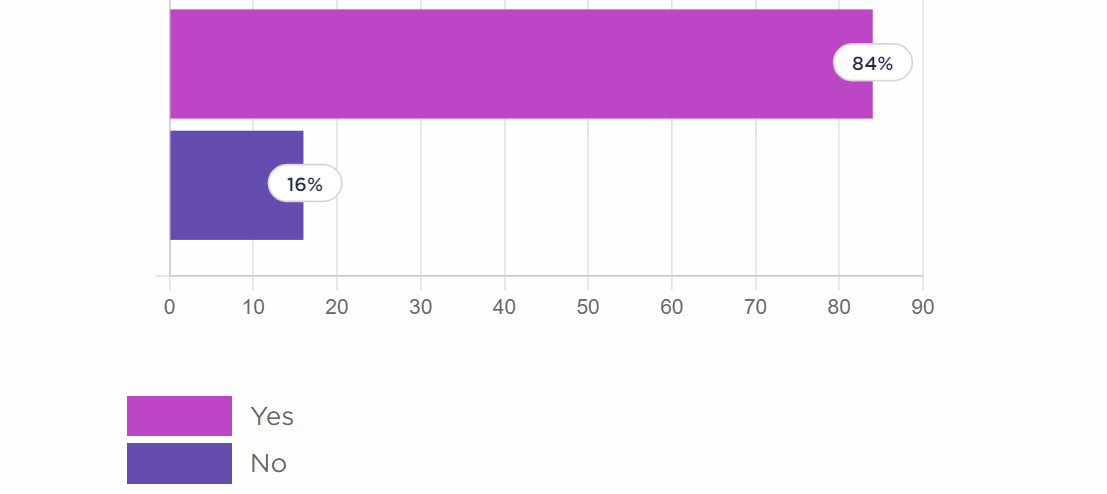
Transformation is focussed on the following areas:
- Sourcing
- Screening
- Candidate management
- Organisation payrolling
- Vendor management systems (VMS)

The takeaway
Trends in the recruitment industry 2022 show that digital transformation remains challenging, with recruiters citing the rapidly changing technological landscape as hard to keep track of. Tech changes all the time, and it’s tough to choose the best window for investment.
Recruiters should seek to adopt a culture of digital transformation, replacing paper processes and manual tasks with automation and technological solutions. Speed and precision are of the essence - and delivering a slick candidate experience is necessary for beating talent shortages.
In short, you need digital processes that help to make the whole recruitment process more agile and efficient. That’s where we come in.
It’s time to embrace the digital transformation of your processes. We’re here to make your processes easy to understand, manage and update. Our intuitive, easy-to-use software transforms your recruitment management processes, so you streamline your pipeline and get your job done efficiently.
Contents
- 2022: The road to recovery
- Priorities for recruitment
- Challenges for recruitment
- Digital transformation
- The takeaway

